Design an Experience : Change of Plan

A Completely Different Outlook

Whilst designing this, I didn’t feel as though I liked the work I was producing, almost like it was lacking something, but not in the idea itself, just in the way I was designing it. And so, I went back to my wireframes, had a little play around nay looking at what people had said about ‘thrill,’ and ‘food,’ and rejigged the way I had laid out my frames, to make the experience a little bit more thrilling. The concept / idea that I had (with the help of Rob) was to fully make the process of receiving your meal, from start to finish, as mysterious as possible. The user in the original concept could choose what they liked and didn’t like, and whilst that remained a key idea, the whole process was flipped to be that of a mystery basket, as the user could favourite meals or whole cuisines into their liked, and from there, the website shuffles and finds meals for them to be delivered, with the user not having a clue what they have actually ordered. When I asked people what they found thrilling, their general response was ‘something new,’ ‘something spontaneous,’ and ‘something they weren’t expecting.’ I feel as though this concept, if done correctly, could represent all of these things, and to start this, I built a few base components. However, I felt as though it didn’t quite match the concept of thrill seekers, so I looked into a different option, which was ‘Gamers.’ I researched different elements of ‘games,’ and landed on the concept of board games, which I eventually chose to focus on monopoly, because it has a strong design system and I felt as though the jargon of ‘rolling the dice,’ and ‘taking a chance,’ would work really well. Below is the process of going from the original idea, to the latest version to carry on with in the ‘Prototyping’ post.

Components Part One

These elements below were a part of an idea that I didn’t continue on with, from here on out, I focused on the components under the post ‘Prototyping’ found here : https://www.nua-ux.design/hanley-whelpton/blog/uncategorized/design-an-experience-prototyping/

I settled on a tinder swipe system in order to create a section where the user could choose their preferences. In order to begin creating this, I had to first make a stack of cards that could be used throughout the webpage. I settled on a rectangular shape with curved edges to match the theme, messed around with type for a little bit, and chose two different colours to add a bit of depth to the stack. I used a handwritten type as shown in the Design System (link) to test some buttons for the user to click, but felt as if it gave away the interactive motion of swiping, which prospective users mentioned they liked the idea of due to the nature of literally throwing something away.
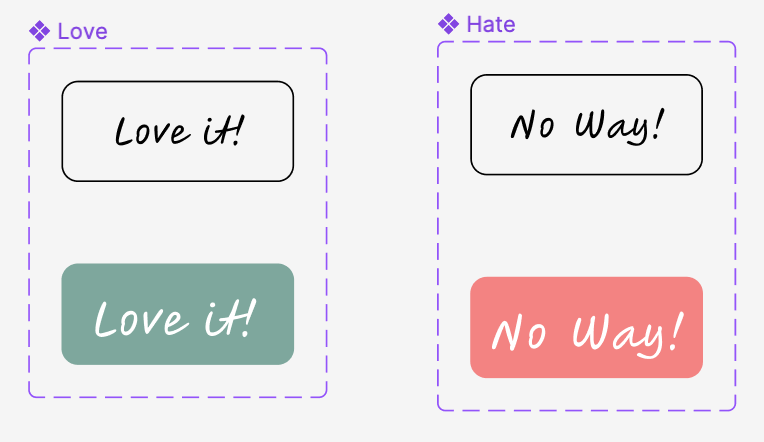
Above are these versions of components, before I decided to change the layout slightly, by placing the emphasis purely on swiping, and having the buttons only pass through the screen when the user interacts as shown below.

I also followed this up by developing some more components that I thought to be useful, as well as ones on the wireframes that followed the Heuristics, such as the clicked state of the navigation bar, giving the user a signifier of their actions. I also created clicked state buttons for the vg, gf, and v options on the page, so that the user could select any and all at the same time, even removing ones previously chosen.

Sliding Interaction

To create the sliding interaction, I first placed all of my componants on the page, and used instances to change their names, add photos to them and create the variations needed to show different ingredients to the user. I then stacked all of these, minimising each one as they went down, to provide an extra elements of growth as the user swipes through. It was important to then make the ‘love it,’ and ‘hate it,’ buttons invisible until the interaction occurs. I originally created the buttons to be ‘love it,’ on the right, and ‘hate it,’ on the left, similar to that of the way that you would swipe on any other device, following the consistency and standards ideology from Neilson’s 10 heuristics. However, when swiping, the user would have less time to be shown this, and so, I swapped the way that the buttons were, and tested it to see if it worked.

I eventually changed the style of this, and the way that the slides looked, however, the process was the same. I looked into swiping left and right after just giving the user instructions, as well as buttons, to see which worked best for the user. I asked 3 people to look at the products prototype, and see which they preferred. I found that. a lot of people went to naturally swipe when they saw the way that the page was designed and laid out.

Wireframe’s Put Against Principles

The wireframes that I had created for this product were really strong, and I kept the design style of them as they seemed to be quite strong mid fidelity wireframes. I put them against the 7 design principles to check they had the aspects needed, and I continued to do this throughout the process to check my components.
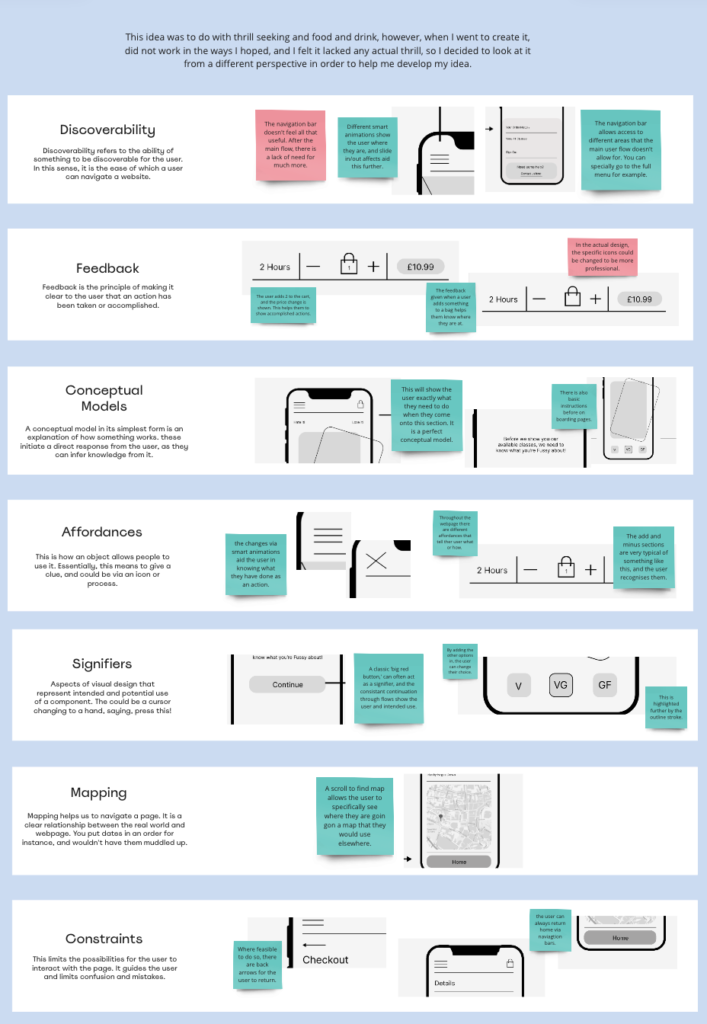
The miro board link for this process : https://miro.com/app/board/uXjVNU5os7A=/?moveToWidget=3458764568471496712&cot=14

Updated Research

I continued to look at food and drinks, as well as what would be considered different ‘gaming,’ techniques etc. This was my research for these sections below!
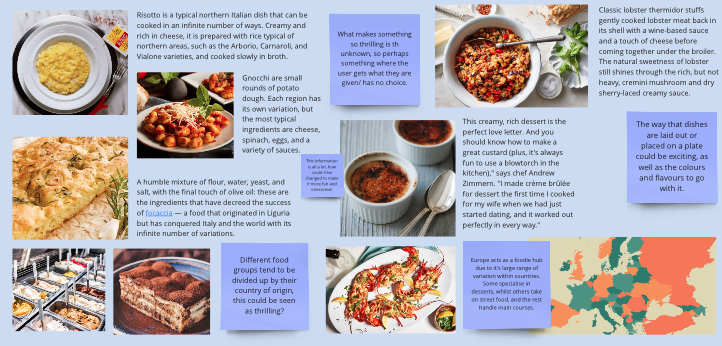
Below is some research for the ‘monopoly,’ central section, where I looked at different design systems, drew up some quick sketchy illustrations to tests style, and looked into concept of character and their history a little bit.

Design for Good : Research

This project had a wide spread research base, as the brief simply stated that the end product would need to act as some sort of environmental aid in the sense of solving an issue.

Base Research

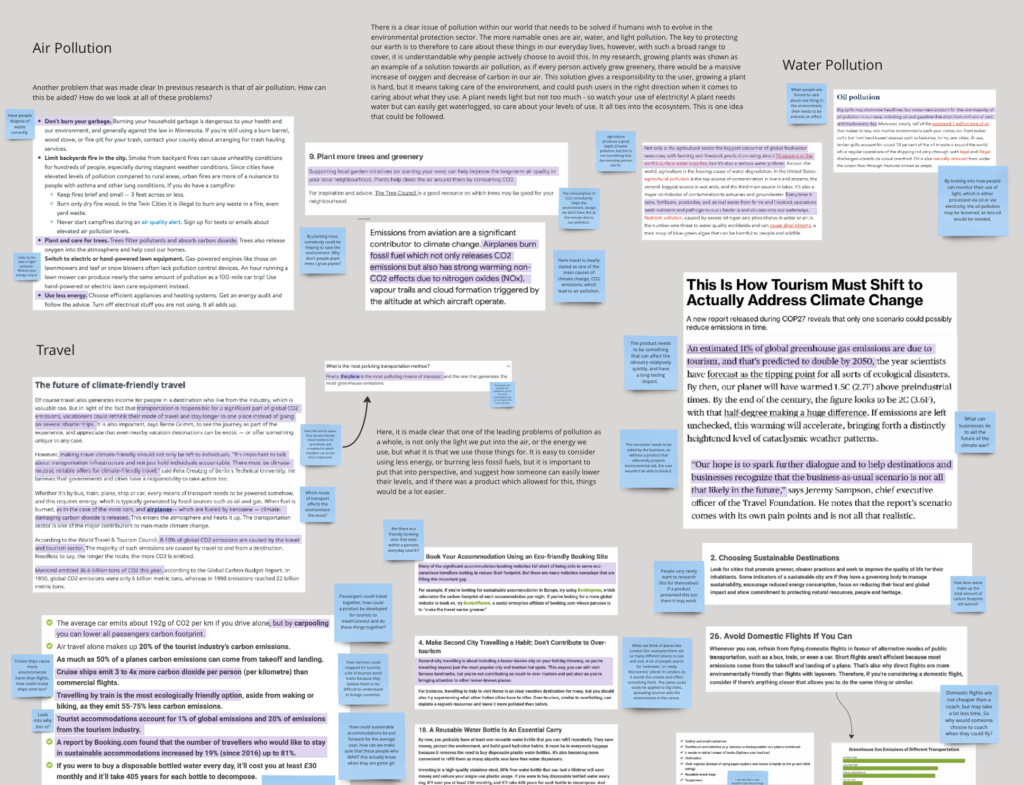
I therefore, began by researching different environmental ‘pains,’ or things that are harming our environment more simply put. WWF provided a great source for these problems, and in the end, I narrowed down my research to looking into various forms of pollution. The main 3 points being that of air, water, and light pollution. I knew a little bit about light pollution already, but I never knew it caused as much of a problem as it actually does, with some countries producing acts against the excessive use of light within certain times, limiting it and therefore its affects, and a fair few studies being produced in order to present the issues light pollution causes.

One study, shown in the Miro board, states that light pollution disrupts natures sleep schedule, causing animals to push their patterns, and therefore weakening the food chain. This then has an affect on us, as we rely on the food chain being balanced for our own products.

Air pollution causes similar issues, with nature being disrupted in their habitats, as colder areas become warmer, pulling nature out of its comfort zone, and putting humans at risk. A similar thing happens within water pollution, as soil takes in harmful chemicals, causing disease and negative evolution within animals, and therefore transferring that to humans.

The project brief that could be summed into once sentence, was therefore a lot larger than anything I could have thought, as in a crit, members of my course presented incredible information that I hadn’t even considered, such as the environmental damages of food waste, clothes production, and even bees!

Miro Board link : https://miro.com/app/board/uXjVNSGXWcQ=/?moveToWidget=3458764569009142983&cot=14

Finding a Problem Space

By the time I had looked into different types of pollution, I had found out a lot of things about the environment, and how we as people are harming it everyday. On elf the problems I chose to dive into further was that of travel.

Travel and tourism is considered one of the largest industries in the world, be it travelling within your country or to one on another continent! And with aircrafts, cruise ships and coaches being the largest contributors to air pollution, the industry also proves to present major issues to the climate. Fuelled by kerosene, airplanes create more negative output during take off and landing than a human will in a whole 5 years.

A few ways were presented to me via this research that could help solve it. One of which was the idea of how we travel. If you were to backpack across 20 town and cities, you would be helping via second city tourism, as well as reducing the flights you would be taking within the country. Backpacking has therefore less of a carbon footprint, as a lot of the time, you are literally walking as opposed to transport that could be harmful for the enviornment. I then looked at where you would book, as there are a few available eco-tourism sites to book on, however, only 2 were available as of the moment.

To me, this problem seemed quite justifiable when it came to an issue causing environmental harm. Travel was clearly pushing toxic fumes into the air, causing air pollution, leaving behind vast amounts of waste, causing water pollution, and contributing towards global warming. In order to move on from this problem space and begin defining ideas for a product, I did have to completely prove it to be an issue, something I did via statistical research.

Statistical Research

I began my statistical research by looking into different industries, and the stats behind how each industry presents the total amount of carbon in our atmosphere, contributing towards global warming, an issue defined in the problem space. In this chart, the information shows that Aviation and shipping, which is a tie in of the tourism industry, lands at 1.13 billion tonnes a year, which, when combined with all of the other factors involved of taking a holiday, such as heating, electric, transport and waste, proves tourism to be a major issue in regards to the environment, as heating and electricity comes in the top at 14.22 billion tonnes.

To back this ups further, I looked at specifically the emissions throughout the transportation sector worldwide, and how that has gradually increased, mirroring this with the figures on how the tourism industry has taken off at the exact same time.

I looked at the energy use in hotels, as well as the food waste left behind from customers when their stay ends, and how this is all has a massive affect on the environment, comparing the statistics use of Barbados to other countries and their waste as an estimate.

I then took a while to focus on the idea of transport itself, and how people get from their house to an airport, to the country on the plane, from that airport to the hotel and so on. The statistic accounted nearly half of all travel fumes to the transport, and then using a similar statistic, I looked at how the different types of transport affect the environment in different ways. I felt this to be important as it would be pointless to create a product counteracting the affect of a ferry for example, when it accounts for 0.7% of all transportation outputs. I then looked at how far people live from airports, because just as much as it is important to look at the flight itself, if an airport was further than 100miles for 90% of people, there is a much larger problem than just aviation. This was not the case however, as most people lived within 0-10 mile radius of an airport, in both the UK and America. If you don’t need to travel to the airport, and your hotel is within the city that you fly too, this suggests the problem to be that of aviation itself, and that when compared with it being the most carbon positive in transport.

I then looked into statistical facts based on peoples opinion, and how they saw different areas of the topic. Some of the reasons that people wouldn’t choose travel tourism could be that of other travel options appealing more to then, as well as the lack of options appearing on a search. This means that someone would need to be able to hear about it, therefore the product created must prove to be a strong brand, otherwise it wouldn’t stand a chance with the 32% of people not even knowing about the product, and the further 29% of people (plus 8% of the same opinion) that don’t see these types of vacations as ‘luxury.’ A good quality brand and product would back up the idea that it is. On the next figure, it is suggested that everyone understands their impact on the environment, and how they could help, via train travel, low emission cars or simply their moral conscious of knowing that what they are putting out is wrong. They also commented on local communities, and how an incredible 66% of people would want to feel authentic cultures, which could be presented within the design of my product. There was a lot of information within this section, however, all opinions, which may change based on design, idea, or concept.

Miro Board Link : https://miro.com/app/board/uXjVNSGXWcQ=/?moveToWidget=3458764569009143113&cot=14

Meet the Mentors

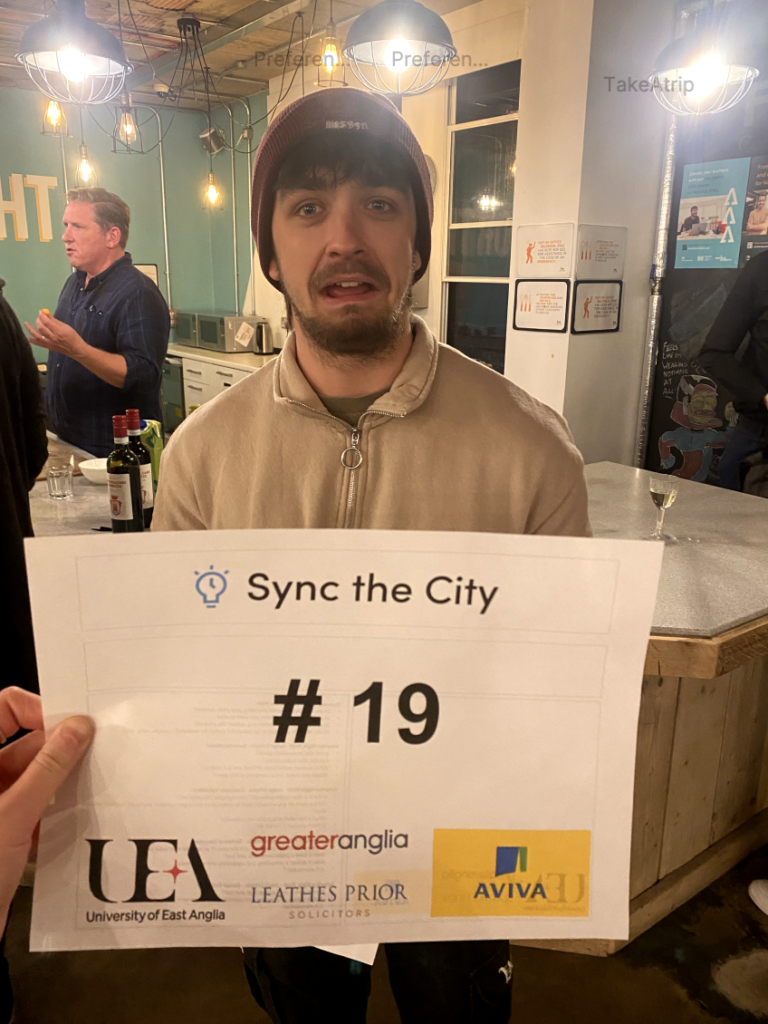
Today me and Fergus went to a meet the mentors event at Sync the City!

We began by finding the building where the event was held, which was ‘Fuel studios,’ a lovely breakout room that was really open, with fun seating like swings and noise cancelling seating areas, which we thought were perfect for socialising and networking – which is exactly what we did!

Whilst it was a little bit scary at first, because everyone there seemed to be a little bit older than us, and members of the industry we hoped to break out into, we were offered some drinks by one of the mentors, a developer named (I forgot name). We sat on the swing seats whilst he told us about the minute long pitches and some of the parts we weren’t sure on, and let us ask him questions about the event, which later on, the event runner (also forgot name) spoke about in more depth, pictured below.

We were told that whilst the one minute pitches were not needed by all members, you would lose nothing by giving it a go, which got me and Fergus thinking of start up companies that we could pitch. After talking it over with one of the mentors, we were offered the chance to present a rough draft to the rest of the group. My idea (please bare in mind I came up with it on the spot,’ was regarding student chat rooms, a source of communication for students linking to societies, accommodation, courses, and anything else, all in one place, as opposed to the 15 group chats on 5 different platforms that a normal user would need to join and manage, something I pointed out in my pitch. I ended the pitch noting that it would be for profit, as an app for student could easily advertise student based events, working with societies and clubs to create revenue for all partners, and stated that whilst not everyone was a uni student once, every uni student was lonely once, and it was important for such communication to be accessible and viable.

Fergus pitched an idea regarding a ticketing app for travel, which I thought was really good! We had a really nice time overall and after meeting a lot of the other attendees, made friends of other arts students, industry professionals, coffee shop owners, gamers, and self proclaimed ‘nerds.’

We ended our night with a celebratory spoons trip, which Fergus would like to comment was ‘a well deserved bevvy,’ after our terrifying pitches, in which I actually enjoyed a lot, and helped me move out of my comfort zone.