University studies have suggested people check their phones 34 times a day, however industry insiders believe this is closer to 150 daily sessions.
‘Impulse to check message notification’
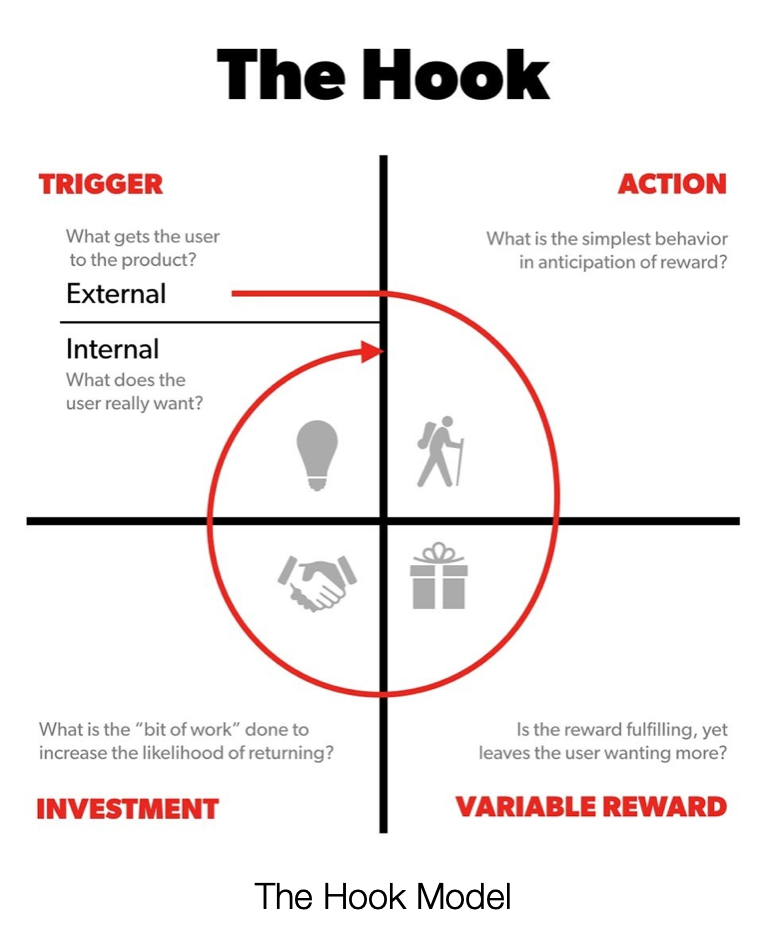
Companies who attach ‘internal triggers’ to their product find that their users come back with no external prompting. Habit forming companies link their services to the user’s daily routine and emotions – instead of relying on expensive marketing.
Through consecutive hook cycles, successful products reach their ultimate goal of unprompted user engagement, bringing users back repeatedly, without depending on costly advertising or aggressive messaging.
Trigger is the driving force that causes a behaviour, and there are two types of trigger: internal and external.
Habit forming services alert users with external triggers, such as an email or even the app icon on a phone.
Cycling through successive hooks means that users start to form associations with internal triggers, which then become attached to already existing behaviours and emotions.
It is when users start to automatically cue their next behaviour, when the new habit becomes apart of their daily routine.
An action is a behaviour that is done with the anticipation of a reward in mind.
This part of the hook greatly focusses on the art and science of usability design and how this can be utilised in order to drive a person’s specific action.
Companies take advantage of two pulleys of human behaviour to increase the likelihood of an action occurring: the ease to perform the action and the psychological motivation to do it.
Variable Reward – the craving of the feedback loop
Variable Rewards are a very powerful tool in hooking users. Studies have shown that the levels of the neurotransmitter dopamine surge when the brain is expecting a reward.
This effect is heightened where variability is implemented. This creates a focussed state which suppresses the parts of the brain which are associated with judgement and reason, and simultaneously activates those areas which are associated with wanting and desire.
‘Exciting juxtaposition of relevant and irrelevant, tantalising and plain, beautiful and common, sets her brain’s dopamine system aflutter with promise of reward’.
Investment phase increases the chance that the user will pass through the Hook cycle in the future.
Investment occurs when the user puts something into the product – e.g. time, data, effort, social capital, or money.
Investment implies an action that improves the services for the future cycle – it is essentially used to improve the users experience, e.g. inviting friends and stating preferences.
[…] to make the process of choosing sustainable choices much easier for the user. Relating back to the ‘hook model’, it was discussed that some kind of animation regarding the switch model would create the […]
[…] talking with Dave with how I wanted to draw the users into my design, he recommended the book ‘Hooked’ by Nir Eyal. I read the first chapter of it and it helped me to understand different methods which I can use in […]
Leave a Reply