Andy Larkin’s visit to NUA was extremely insightful and useful, with the opportunity to share our projects with him after his lecture/presentation beforehand.
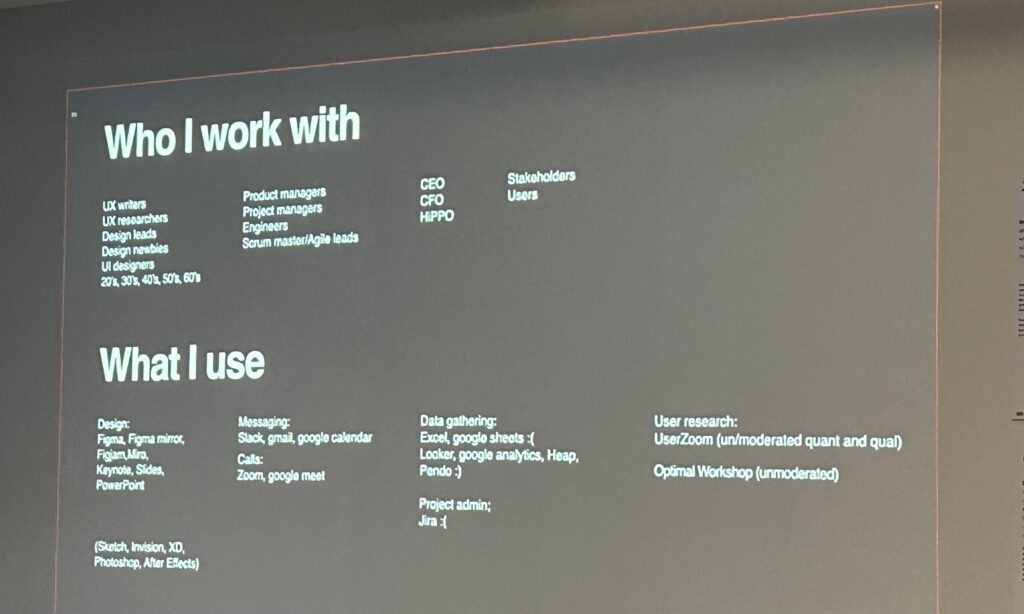
Andy started as a UCD Designer, then transitioning to a UX & UI Designer, then to a UX Consultant, and now to a Product Designer. Andy highlighted how software in the industry has changed through his time in these roles – while working as a UX & UI Designer, Sketch and InVision were the two main platforms for design and prototyping. Now, it has transitioned to Adobe XD & Figma – an important reminder of how this industry is constantly evolving.
He went on to speak about the process and practice of interviewing people next – something especially relevant to Project 4 at the moment. Below are some notes I made:
- Preparation
- Tight script
- Consider legal/GDPR (ask for consent)
- Choose priority questions
- Prepare extra questions
- Focus on 2-3 main things you want to find out an answer for
- Observer – silent partner to listen and take notes can be useful
- Be organised, make eye contact, engage
- Manner – build a rapport at the beginning, but be neutral in the main part of the interview
- Paraphrase their responses back to them to gain clarity
Andy also talked about ‘Discovery Workshops’ which he does – using Miro or FigJam – with interactive elements that can be dragged around, such as cards instructing team members to rank site content in order of importance. Within these, he also uses Plotting Workshops – to position things on triangles or sliders against a scale such as Now vs Future focusses.
Several more tips and pieces of advice:
- UX Follows a process, and businesses want to move faster
- Educate people on the value of what you do and why it is important
- Ask what people do now, not what they want
- Practice giving and receiving feedback
- Justifying design decisions to indifferent/bored people
- You are not your idea – be open to criticism
Top 10 Tips:
- Be nice (but not a pushover) – who you know is very important
- Work with talented people – inspiring people, who are smarter than you, is the quickest way to learn
- Ask – sit in on client presentations, CEO testing
- Challenge people – respectfully, and be open when challenged
- You’re an expert
- You have advantages – young, new, up for it, time & space, grown up with devices and apps
- Marathon not a sprint
- Be reliable – what does manager value?
- You will mess up
- Ask why – don’t just be receptive, be proactive, question brief