Pivot
Initially, I had the idea of writing my paper on how children interact with technology and whether we can understand their interaction on a fundamental level to apply this to our own design languages. However, the more I researched, the more I found data about the negatives of tech and children, with little information on what I wanted to know. There were many studies on language acquisition at an early stage, but linking it back to my own research would require conducting my own studies. I did not have the resources for this, and I didn’t want to deal with the ethics committee as it was unnecessary stress.
A Change
At this point, I was getting bogged down with the research proposal as the research I was finding wasn’t great or relevant, and I was discussing topics that didn’t interest me. So, I went back to the drawing board and asked myself:
- What do I want to write about?
- What do I enjoy learning about?
- What do I want to achieve?
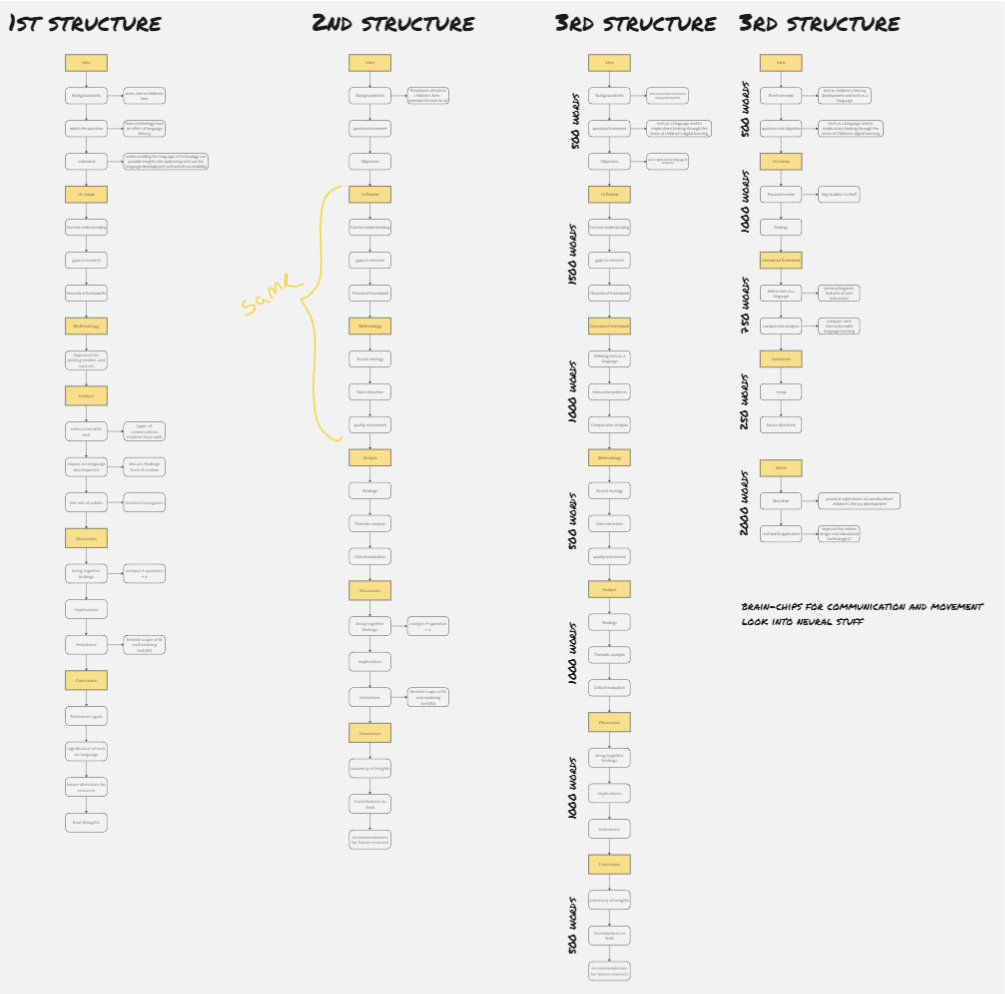
With this, I came up with a new working title: “The Language of Interfaces: Using Linguistic Principles to Foster Accessibility and Enhance UX.” This aligned much more with my goals. I enjoy language and etymology, I want to help those who need accessibility, and I enjoy learning about design. With this, I developed a new structure.

SMART Goals
My friend introduced me to a concept called SMART. Below is a SMART outline with my answers to each category:
- Specific: Clearly define the objectives of the dissertation.
- Measurable: Determine how to measure the success of the research.
- Achievable: Ensure the goals are realistic given the resources and time available.
- Relevant: Align the research with my interests and career goals.
- Time-bound: Set a timeline for completing each stage of the dissertation.
This dissertation will be a bit tricky as it’s ambitious and unrealistic in scope; however, I believe I’m interested in the topic well enough to put my best foot forward.

The proposal
I wrote a draft of my proposal by following and answering each stage of the flow chart I had made for my structure. This way, I knew I wasn’t missing any important steps. Afterwards, I sent it through a language model AI (Perplexity) to format it nicely. This provided me with a decent starting point to finish the proposal, although I did have to add and change a fair bit to it.

Miro
As a side note, I use Miro almost exclusively for my work as it suits my erratic brain and allows me to keep everything in one place so it doesn’t get lost. If I find an article or data that might be relevant, I’ll just place it near the relevant section, and if I don’t use it, I’ll move on. For anyone reading, I recommend switching to Miro for regular work rather than just for UX-focused tasks or group projects. I hope this helps someone!
Leave a Reply